
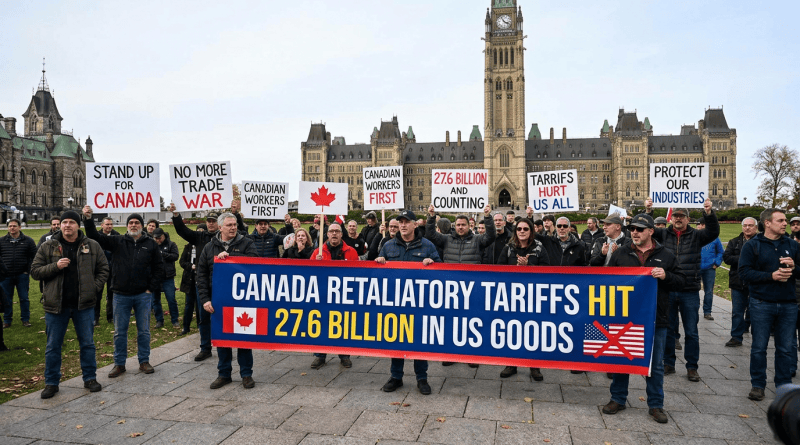
Canada Retaliatory Tariffs Hit 27.6 Billion in US Goods
The trade landscape between the United States and Canada has entered a new and troubling phase. On September 8, 2026, Canada enacted retaliatory tariffs on $27.6 billion worth of American goods, marking a significant escalation in what was once one of the world’s most cooperative bilateral trade relationships. The duties range from 15% to 50% across hundreds of U.S. products, touching everything from dairy and agricultural equipment to household appliances and electronics.
For business leaders, supply chain managers, and entrepreneurs on both sides of the border, this development demands immediate attention and strategic recalibration. The era of frictionless U.S.-Canada commerce, long taken for granted, is giving way to a period of heightened costs, regulatory uncertainty, and competitive disruption.
What the New Tariffs Cover
Canada’s retaliatory measures are comprehensive and deliberately targeted. The highest tariff rate of 50% applies to U.S. steel, aluminum, and iron products, furniture, motorbikes, clothing, and select beauty products. A 15% rate covers a broader basket including dairy, agricultural equipment, paper, household appliances, and electronics. These new duties are layered on top of existing Canadian counter-tariffs, including a 25% levy on the politically sensitive auto sector that remains in force.
The Canadian government characterized the move as a “dollar for dollar” response to U.S. Section 338 tariffs imposed on Canadian goods. According to Canada’s Department of Finance, the tariffs are designed to protect Canadian workers, producers, and manufacturers by allowing them to better compete with U.S. products sold in the domestic market.
The Collapse of Trade Talks
These tariffs did not emerge in a vacuum. Trade negotiations between Washington and Ottawa fell apart at the end of August 2026, with officials on each side publicly blaming one another for the failure to reach a deal. The disagreement extended beyond mere posturing, with both sides openly disputing which specific areas proved insurmountable.
The diplomatic atmosphere has continued to deteriorate. U.S. President Donald Trump called for a boycott of Canadian aerospace manufacturer Bombardier, posting on Truth Social: “NO MORE SELLING BOMBARDIER IN THE UNITED STATES!” Canadian Prime Minister Mark Carney fired back, stating Canada would resume trade talks only “when the Americans are ready,” a pointed rebuke directed at Commerce Secretary Howard Lutnick.
Scale of the Economic Relationship at Risk
To understand the stakes, consider the sheer volume of commerce between these two nations. The United States exported $333.6 billion in goods to Canada in the most recent annual data, while importing $381.9 billion from its northern neighbor. The two countries share deeply integrated supply chains across multiple sectors:
- Energy: Oil, natural gas, and refined products flow across the border in both directions
- Vehicles and auto parts: Cross-border manufacturing chains mean components may cross the border multiple times before final assembly
- Heavy machinery and equipment: Construction, mining, and agricultural equipment industries rely on bilateral trade
- Aerospace: Aircraft manufacturing, including Bombardier and U.S. suppliers, depends on integrated supply chains
- Pharmaceuticals: Drug manufacturing and distribution networks span both countries
- Consumer goods: Furniture, clothing, gems, jewelry, and a wide range of food and beverage products
While economists note that the directly impacted goods represent a relatively small portion of overall trade between the two nations, the ripple effects are expected to be significant, particularly for small and medium-sized businesses and those operating in the most heavily tariffed sectors.
Impact on Small and Medium-Sized Businesses
Large multinational corporations often have the resources to absorb tariff costs, restructure supply chains, or pass expenses along to consumers. Small and medium-sized enterprises (SMEs), however, face a far more precarious situation. Many SMEs operate on thin margins and lack the flexibility to rapidly source alternative suppliers or absorb a 50% duty on imported goods.
For a small furniture retailer in Toronto that imports American-made products, a 50% tariff could effectively double the cost of inventory. For a mid-sized electronics distributor in Michigan that sources components from Canadian manufacturers, the cumulative effect of layered tariffs on both sides of the border could compress margins to the breaking point.
Recognizing this vulnerability, the Canadian government announced a $7.5 billion support package for businesses and workers in August 2026, building on an existing $25 billion commitment made in response to the broader U.S. tariff offensive that began in April 2025. This brings total Canadian government business support to over $32 billion, a figure that underscores the severity of the economic disruption.
Strategic Responses for Business Leaders
In an environment of escalating trade barriers, business leaders must adopt proactive strategies to protect their operations and margins. Several key approaches merit consideration:
1. Supply Chain Diversification
Companies that have relied exclusively on U.S.-Canada trade routes should accelerate efforts to diversify their supplier and customer bases. This may involve sourcing from domestic alternatives, exploring markets in Mexico under the remaining USMCA framework, or looking further afield to Asia-Pacific or European partners. While diversification carries upfront costs and logistical complexity, it provides essential resilience against tariff volatility.
2. Tariff Engineering and Product Reclassification
Tariffs are applied based on product classification codes. Businesses should work with trade attorneys and customs brokers to ensure their products are correctly classified and to explore whether modest product modifications could place items in lower-tariff categories. This practice, known as tariff engineering, is entirely legal and can yield substantial savings.
3. Leveraging Government Support Programs
Canadian businesses should thoroughly investigate the $32 billion in government support now available. These programs may include direct financial assistance, tax relief, loan guarantees, and worker support measures. Failing to access available support could mean leaving critical resources on the table during a period of significant financial pressure.
4. Price Strategy and Customer Communication
Some businesses will need to pass at least a portion of tariff costs along to consumers. Transparency is key. Customers are more likely to accept price increases when they understand the external factors driving them. Clear communication about tariff impacts, rather than silent price hikes, can help preserve customer trust and loyalty.
5. Scenario Planning and Financial Stress Testing
Finance teams should model multiple tariff scenarios, including the possibility of further escalation. Stress-testing cash flow, profit margins, and working capital under various tariff rate assumptions will reveal vulnerabilities before they become crises. This analysis should inform decisions about inventory levels, capital expenditure timing, and credit arrangements.
Broader Economic Implications
The U.S.-Canada trade rift extends beyond bilateral commerce. It threatens to reshape North American competitiveness at a time when global supply chains are already under pressure from geopolitical tensions, climate-related disruptions, and technological transformation. Integrated industries such as automotive manufacturing, where components routinely cross the border multiple times during production, face compounding cost increases that could make North American production less competitive relative to Asian and European alternatives.
Financial markets have responded with increased volatility, particularly in sectors with heavy cross-border exposure. Investors are recalibrating expectations for companies with significant U.S.-Canada revenue streams, and analysts are revising earnings forecasts downward for firms in the most impacted industries.
Looking Ahead
The path to resolution remains unclear. With both sides publicly entrenched and domestic political considerations driving hardline positions, a near-term breakthrough appears unlikely. Business leaders should prepare for an extended period of tariff pressure and plan accordingly.
That said, the deep economic interdependence between the United States and Canada creates powerful incentives for eventual reconciliation. The $715 billion bilateral trade relationship supports millions of jobs in both countries, and prolonged disruption will generate mounting political pressure from affected industries and workers.
For now, the operating environment demands vigilance, adaptability, and strategic foresight. Businesses that move quickly to diversify supply chains, optimize product classifications, access available support, and communicate transparently with stakeholders will be best positioned to weather this storm and emerge stronger when calmer heads ultimately prevail.
Edited by Palawan @QUE.COM
Website: https://QUE.COM Intelligence
Sponsored by: https://MAJ.COM AI Autonomous
Discover more from QUE.com
Subscribe to get the latest posts sent to your email.