
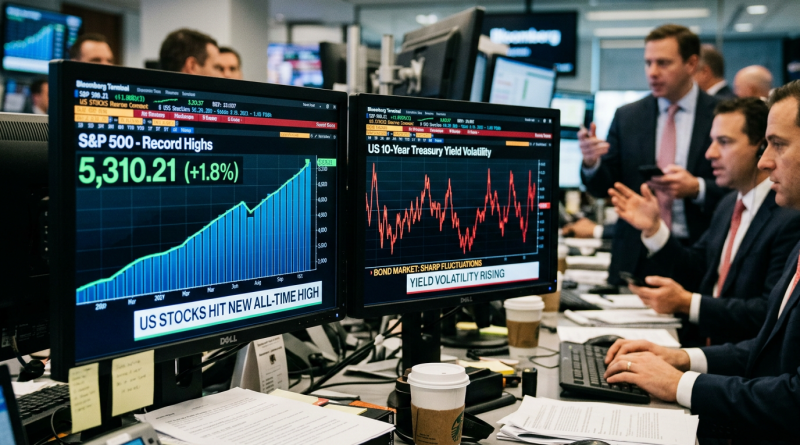
US Stock Markets Hit Record Highs Amid Bond Market Jitters
The American stock market is experiencing one of its most remarkable rallies in recent memory. The S&P 500 surged past 7,700 for the first time in history, while the Dow Jones Industrial Average climbed to a staggering 54,085.88, setting new records on consecutive trading days. Yet beneath the surface of this euphoric rally, bond markets are flashing warning signs that demand attention from every serious investor.
The Record-Breaking Rally
Wall Street’s benchmark S&P 500 index rose 1.8 percent in a single trading session to shatter its previous record of 7,620.90, which had stood since June 2. The index has now gained 12.80 percent year-to-date, comfortably outpacing its historical average annual return of approximately 10.5 percent. The Dow Jones Industrial Average mirrored this performance, climbing 1.7 percent to set a new all-time high for the second straight day.
Several factors are driving this extraordinary momentum:
- Strong corporate earnings: Companies like Palantir Technologies posted forecast-beating quarterly revenue of $1.94 billion, sending shares soaring nearly 30 percent in a single session.
- Geopolitical de-escalation: Hopes for a deal to reopen the Strait of Hormuz have eased oil price pressures and boosted investor confidence.
- AI-driven growth: Artificial intelligence investments continue to fuel corporate profit expectations and equity valuations across the technology sector.
- Global market contagion: Asian markets followed Wall Street’s lead, with Japan’s Nikkei 225 jumping 3.7 percent and South Korea’s Kospi rising 3.8 percent.
The Bond Market’s Contrarian Signal
While equity investors are celebrating, the bond market is telling a different story. Treasury yields have been on a volatile ride, initially sliding as Iran tensions eased but remaining elevated by historical standards. The core concern is that the US economy may be overheating, creating conditions that could force the Federal Reserve into uncomfortable policy decisions.
Bond market participants are increasingly worried about several interrelated dynamics:
- Fiscal deficit expansion: Government spending continues at a pace that many economists describe as overstimulation, pouring fuel on an already hot economy.
- Inflation persistence: Despite the Federal Reserve’s efforts to bring inflation down to its 2 percent target, price pressures remain sticky in key sectors.
- Rate hike expectations: Prediction markets have sharply increased the odds of a Federal Reserve rate hike, with some analysts seeing a move as soon as late 2026.
- Yield curve volatility: The back-and-forth movement of Treasury yields reflects deep uncertainty about the future path of monetary policy.
What the Federal Reserve Is Watching
The Federal Reserve finds itself in an increasingly difficult position. On one hand, the labor market remains robust, with strong hiring reported in recent jobs data. On the other, the combination of tariffs, geopolitical conflict, and fiscal profligacy creates a complex web of inflationary pressures that resist simple solutions.
The Fed’s challenge is compounded by the fact that two regional Federal Reserve banks have announced a pilot survey of the private credit market, a rapidly growing but opaque corner of the financial system that many regulators fear could harbor hidden risks. This initiative signals growing concern within the central banking system about financial stability in an era of elevated asset prices.
Oil Prices and the Strait of Hormuz
Energy markets remain a critical variable in the financial outlook. Brent crude futures fell approximately 5 percent overnight on hopes for a diplomatic breakthrough regarding the Strait of Hormuz, which transported roughly one-fifth of global oil supplies before the outbreak of the US-Israel war on Iran in late February. As of the latest trading, Brent stood at $79.98 per barrel.
US Secretary of State Marco Rubio expressed optimism that a deal to reopen the critical waterway could be reached imminently, while Treasury Secretary Scott Bessent told CNBC that an agreement could come within days. Iran’s Foreign Ministry spokesperson described ongoing talks with Omani officials as positive.
However, the situation remains fragile. Maritime traffic through the strait has been severely constrained, with only nine vessels transiting on a recent Sunday compared to roughly 130 daily crossings before the conflict. The US military maintains that the strait is open, but the gap between official statements and commercial reality underscores the geopolitical risk premium embedded in energy prices.
The AI Investment Boom
One of the most significant structural supports for both equity markets and the broader economy is the artificial intelligence investment cycle. The World Economic Forum has noted that the AI boom is helping to insulate global growth from geopolitical shocks, creating a powerful countercyclical force.
Companies across industries are pouring capital into AI infrastructure, from data centers to specialized semiconductors, driving a capital expenditure cycle that supports employment, demand for industrial materials, and corporate earnings. However, some analysts question whether the magnitude of AI spending is justified by current revenue streams, drawing parallels to previous technology investment cycles that ended in corrections.
Balancing Optimism with Caution
The tension between the equity market’s optimism and the bond market’s caution is not merely an academic debate. It has real implications for investors, businesses, and policymakers. When stocks and bonds send conflicting signals, history suggests that the bond market often proves to be the more accurate predictor of economic turning points.
What Investors Should Watch
For investors navigating this complex landscape, several indicators deserve close attention:
- Federal Reserve communications: Any shift in language regarding rate hikes or cuts will move markets instantly.
- Jobs data: Monthly employment reports remain the single most important data point for monetary policy expectations.
- Oil prices: A diplomatic breakthrough on the Strait of Hormuz could send crude sharply lower, while a breakdown could reverse recent gains.
- Corporate earnings guidance: Whether companies sustain their strong performance or begin to signal caution will shape market direction.
- Treasury yield movements: A sustained rise in yields could challenge equity valuations, particularly in growth stocks.
Conclusion
The current market environment represents a fascinating study in competing narratives. Equity investors are betting that strong earnings, AI-driven growth, and geopolitical de-escalation will continue to power markets higher. Bond investors, by contrast, are pricing in the risk that an overheating economy, persistent inflation, and fiscal excess will eventually force a painful adjustment.
Both markets cannot be right indefinitely. The coming months will reveal whether the stock market’s optimism or the bond market’s caution proves to be the better guide. In the meantime, prudent investors would do well to maintain diversified portfolios, stay informed about Federal Reserve decisions, and prepare for the possibility that the current euphoria may give way to a more challenging environment.
Edited by Palawan @QUE.COM
Website: https://QUE.COM Intelligence
Sponsored by: https://MAJ.COM AI Autonomous
Discover more from QUE.com
Subscribe to get the latest posts sent to your email.